I meet Sofie on the shop floor, three months after the redesign opened. The space is bright, unhurried, full of small corners that invite you to stop. It doesn't look like any retail concept I've seen in a benchmark report. I tell her that. She grins. "That's the whole point."
Sofie leads the retail design team for a Danish lifestyle brand. Last year, she and five colleagues were tasked with redesigning their flagship store. "We had everything," she says. "Mood boards, competitor walkthroughs, heat maps, footfall data. What we didn't have was a single idea that felt new. Everything we sketched was a version of something we'd seen somewhere else."
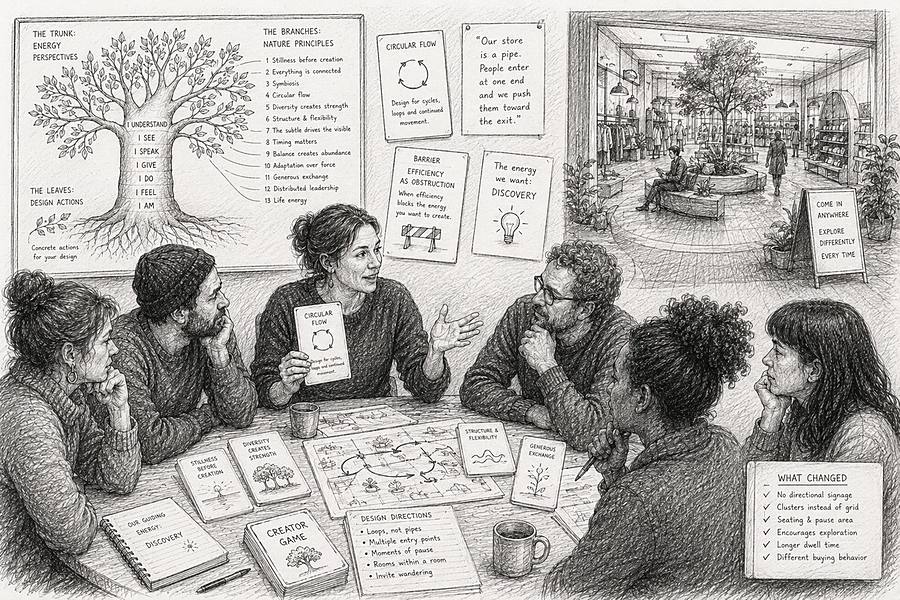
The team had been stuck for weeks when a facilitator suggested the Creator Game — a card-based design tool structured around a tree. The trunk is energy perspectives. The branches are nature principles. The leaves are design actions. "We were used to starting at the leaves," Sofie says. "Move this shelf, change that colour. The game wouldn't let us. It said: start at the trunk."
I ask her what that meant in practice. "The first card didn't ask where the checkout should go. It asked what energy the space should hold for someone walking in." She laughs. "We sat with that question for twenty minutes. Someone said 'calm.' Someone else said 'discovery.' A third person said 'efficiency.' And then we realised — those three things are in tension. Our old store had been trying to do all of them. It was a compromise dressed up as a concept."
Jonas, the team's visual merchandiser, picks up the story. "There was this one card — 'Circular flow.' I remember reading it and thinking, that's interesting but abstract. Then someone said, 'Our store is a pipe. People enter at one end and we push them toward the exit.' And suddenly it wasn't abstract at all."
The team began sketching a layout where movement loops instead of flows in one direction. Customers could enter from different points and encounter the space differently each time. "It felt weird," Jonas admits. "Everything we'd been trained on said: create a clear path. The card said: create a journey that folds back on itself."
But the card that changed everything, according to Sofie, was a barrier card. The Creator Game includes cards that name forces blocking creative energy. "Ours said something like 'efficiency as obstruction.' And we all just looked at each other." Their old designs had been optimised for speed — how quickly can someone find what they need, pay, and leave? But the energy they'd chosen was discovery. Discovery requires lingering. Wandering. Finding things you weren't looking for. "Efficiency was literally fighting the feeling we wanted to create," she says. "And we'd never questioned it."
I ask what they changed. Jonas walks me through the space. "We took out the directional signage. We broke the grid into clusters — small zones that feel like rooms inside a room. And see that area in the middle?" He points to a seating area with plants and soft light. "That does nothing commercially. It's just a place to sit. Our finance guy almost had a heart attack." He grins. "But foot traffic in the surrounding zones went up thirty percent. People stay longer. They buy differently — more exploratory, less task-driven."
Sofie walks me to the entrance. The fixtures are largely the same as before. The products haven't changed. "What changed," she says, "was the logic underneath. Before, the question was 'how do we move people through?' Now it's 'how do we create conditions for discovery?' Same materials, completely different store."
Before I leave, I ask her whether the game felt like a risk. She thinks for a moment. "It felt like a risk to play cards in a room full of retail professionals, yes. But the real risk was doing another benchmarked redesign and wondering why it felt exactly like everyone else's."