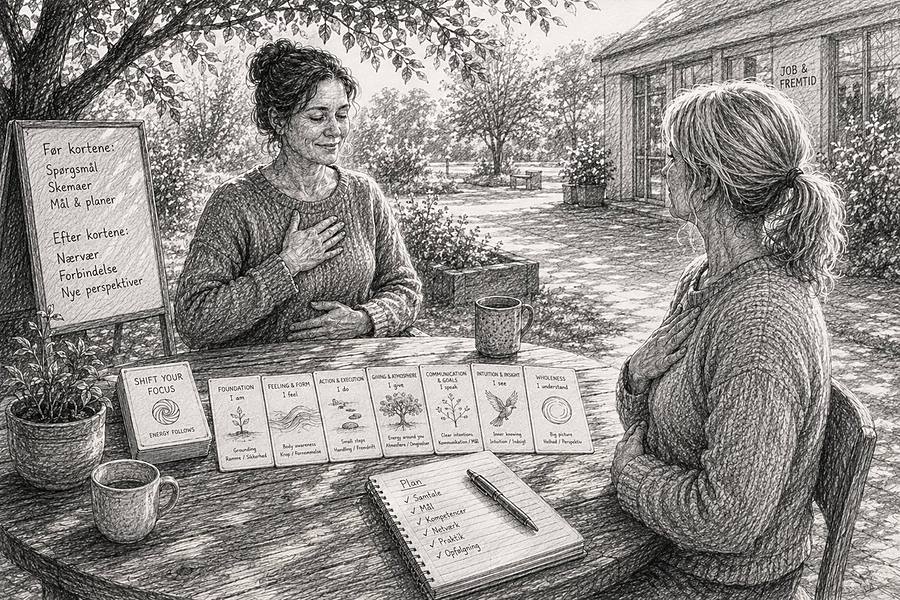
Line has been a change agent in a municipal employment programme for seven years. She works with citizens going through what she carefully calls "difficult transitions" — job loss, long-term illness, the slow erosion of confidence that comes with being outside the workforce. When I ask her to describe her typical day before the cards arrived, she's blunt. "Forms. Goal-setting templates. Action plans with milestones. And a person sitting across from me who couldn't talk. Not because they didn't want to. Because the format — me asking, them answering — activated exactly the part of them that was stuck."
She first encountered Shift Your Focus at a workshop and brought the cards into her practice quietly. No pilot programme. No management briefing. "I just put them on the table one day and said, 'Can we try something?'"
The first person she tried it with was a woman in her late forties, out of work for eighteen months after a back injury. "She'd been through the system," Line says. "The interviews. The plans. The follow-ups that feel like check-ups. She came in polite and completely closed." Instead of opening an intake form, Line placed the deck on the table and invited her to draw from the Foundation perspective — Ramme/Sikkerhed. The card was a grounding exercise: plant your feet, feel your weight settle, breathe into the floor beneath you.
"And then the part that mattered," Line tells me. "I did it with her. I didn't sit there watching her do an exercise. I planted my feet. I breathed into my weight. For maybe ninety seconds, we were just two people in a room doing the same thing." She pauses. "That's when the hierarchy dissolved. I wasn't the helper. She wasn't the case. We were just... together."
Afterward, the woman could talk. "Not because the exercise fixed anything," Line is careful to say. "Her back still hurt. Her money situation was still bad. But she started from a different place. From the body instead of the head. And from there, she could find words that hadn't been available five minutes earlier."
I speak with two other agents from the same programme. Peter, who works primarily with younger citizens, tells me about a man in his twenties who'd been stuck in what Peter calls "the loop" — the same worries circling through his mind, week after week. "I gave him a card from the Intuition perspective. The exercise asked him to put his hand on his stomach and just notice. Not name anything. Not analyse. Just feel." Peter shakes his head. "He said it was the first time in weeks his thoughts had been quiet long enough for him to hear what was underneath them. And what was underneath wasn't anxiety. It was grief. We'd never have gotten there through a form."
I ask the agents what surprised them most. Line answers immediately. "How much it changed us. Not just them." She explains: the traditional model puts the agent in the expert seat. You have the plan. You have the pathway. The citizen is the one who needs help. "But when you sit across from someone and do a breathing exercise together, you can't be the expert anymore. You're sharing attention. You're present. And I was so much less exhausted at the end of the day."
Peter agrees. "The cards became a ritual. Not something the programme required — just something we all started doing at the start of every session. Citizens began to expect it. One woman told me it was the only part of her week where she didn't feel like a case number."
Line's colleague Maria, who I reach by phone, puts it differently. "The cards gave me permission to be a human being in a system that wants me to be a process. Two minutes of breathing together before we open the forms. It changes everything that comes after."
Before I hang up, I ask Line if she can explain why it works. She thinks for a long time. "Perspective change doesn't need a big idea. It doesn't need a breakthrough. It just needs a different place to stand. Something so small you barely notice it — until you look up and realise you're seeing things you couldn't see a moment ago. That's what the cards do. They don't give you a new thought. They change where you're thinking from."