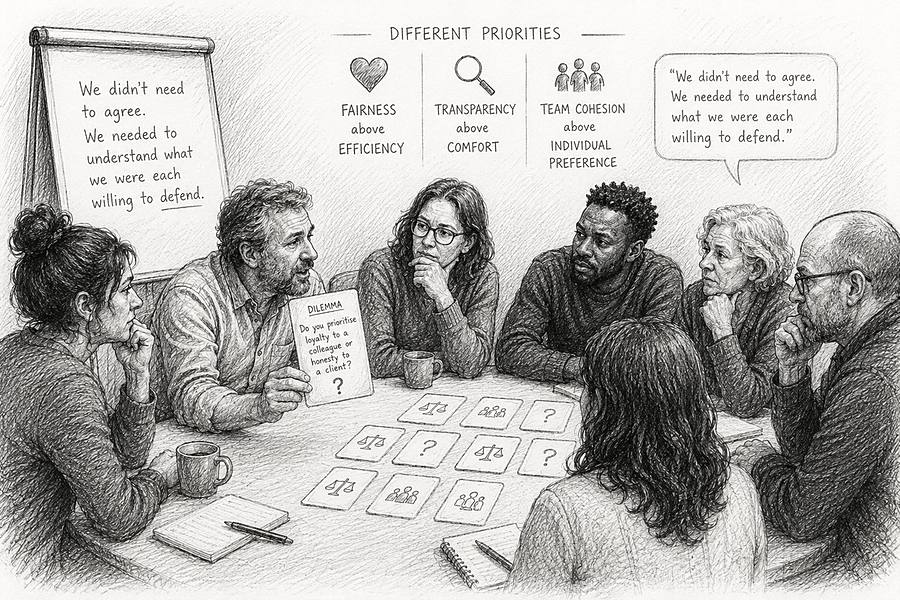
When I meet Mette K., head of internal development at a mid-sized Danish organisation, she laughs before I even finish my first question. "You want to know what happened? Fourteen people walked in thinking they agreed on everything. By lunch, we knew we didn't. And that turned out to be the most useful thing we'd done in two years."
The brief had been simple enough. Two days. Shared values. The kind of exercise that usually ends with a laminated poster in the kitchen and a collective sigh of relief. But Mette's team brought in the Dilemma Game — a card-based tool where each card presents a real-world ethical situation with no clean answer. No right side. No wrong side. Just the tension.
"The very first card," Mette recalls, leaning forward. "Thomas read it out loud, put it down, and said 'Well, obviously we report it.' And three people at the other end of the table just went — no." She shakes her head, smiling. "Not angry. Just completely certain he was wrong. And he was completely certain they were. That's when I thought, okay, something real is happening here."
I ask Thomas about that moment later, over coffee. He's quieter than I expected. "I remember feeling genuinely confused," he says. "I thought we all shared the same instinct about that kind of thing. Turns out we didn't. We shared the same vocabulary, but we were pointing at completely different things with it."
What followed, according to several participants I spoke with, was unlike any team exercise they'd been through. The cards kept coming. Each one forced a choice between two values that both felt right — loyalty vs. honesty, individual fairness vs. group cohesion, following policy vs. doing what felt human. And each time, the room split.
Anette, who leads their compliance team, describes the shift that happened around the fourth or fifth card. "We stopped trying to win. Someone — I think it was Lars — said, 'I don't think you're wrong, I just think you're weighing it differently.' And after that, it felt safe to actually say what you believed. You weren't attacking anyone. You were just showing your cards. Literally."
By the afternoon, something had changed in the room. Not the volume — people were still passionate. But the quality of the disagreement was different. "I told Thomas I thought his position was dangerous," Anette says, and then pauses. "And he thanked me. That had never happened before."
Mette is careful to point out what the session did not produce. "We didn't walk out with a values poster. We didn't resolve anything. But we built something I hadn't been able to build in two years of workshops: the ability to sit in a disagreement and not panic. To hold the tension without someone shutting it down or someone else leaving the room."
I ask her whether that's lasted. She thinks for a moment. "Last month we had a real dilemma — not a card, a real one. A staffing decision where two valid perspectives were clashing. And instead of escalating it, the team just... talked it through. Someone actually said, 'This is a Dilemma Game card.' And everyone laughed and leaned in." She pauses again. "That's when I knew it had actually worked."